Free · open source (MIT) · Claude Code plugin
- Live pane in every session: tokens, context fill, plan limits
- Local dashboard with 90 days of history
- Counts each response once, unlike tools that sum every log line
For Claude Code and other coding agents
Two tools that work together. Tokenmeter shows where your Claude Code tokens go, live. TokenDiet cuts what your instructions add to every request, without making your agent any less capable.
Both run on your computer. Nothing is sent anywhere.
Instructions per request
Before TokenDiet2,865 tokens
After TokenDiet409 tokens
Free · open source (MIT) · Claude Code plugin
$15 one-time · Agent Skill
Every request your agent sends carries the whole conversation and your instruction files. Tokenmeter makes that visible; TokenDiet makes it lighter.
Tokenmeter shows each session's tokens and context fill, and suggests a diet when the context passes half the window or the prompt cache keeps missing.
TokenDiet measures your CLAUDE.md, AGENTS.md and rules files, proposes lossless fixes, and applies the ones you approve.
Each audit shows up in Tokenmeter's dashboard as that project's instruction weight, before and after.
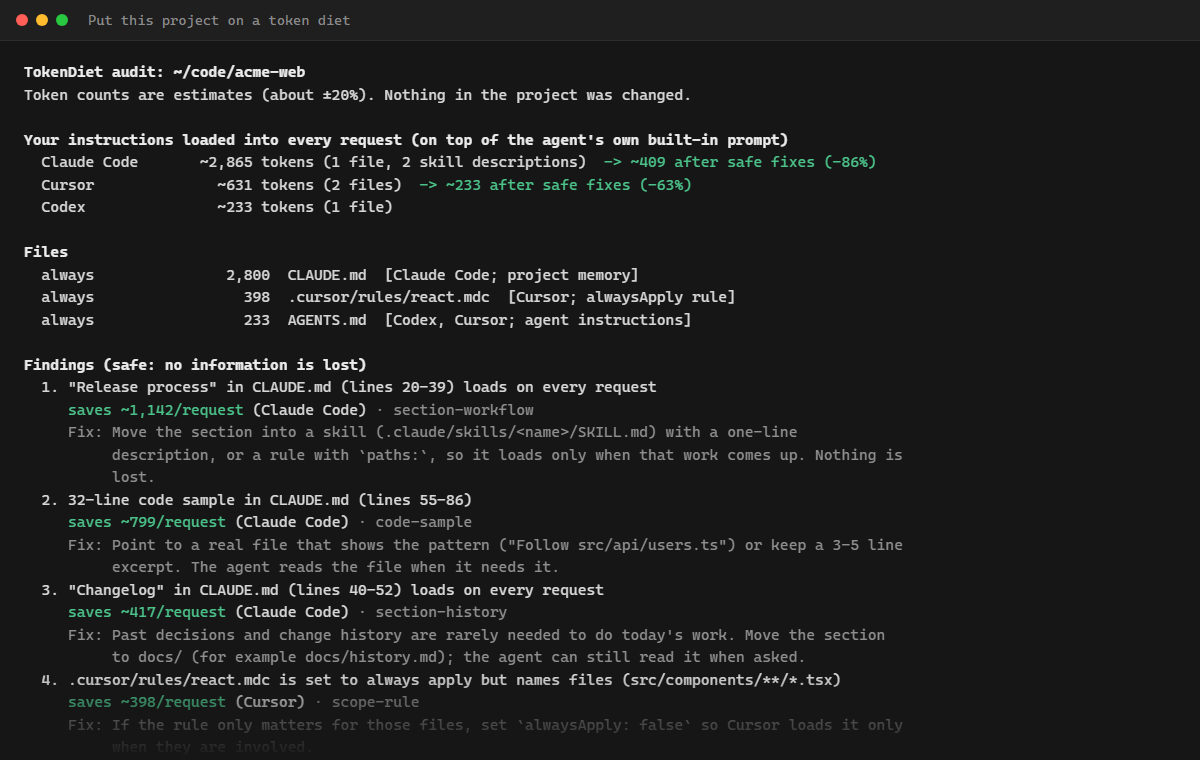
Measured on the demo project that ships with TokenDiet. Your results depend on your setup. Counts are estimates within about ±20%.
Both tools read files on your computer and send nothing anywhere. No account, no API key.
TokenDiet asks before every change and backs up every file it edits. One command undoes it.
This website sets no cookies and loads nothing from other sites. See the privacy policy.
No. Each works on its own. Tokenmeter shows where your tokens go; TokenDiet reduces what your instructions add to every request. Used together, Tokenmeter also shows each TokenDiet audit and suggests one when a session gets heavy.
Yes. Tokenmeter is open source under the MIT license, with the code on GitHub. TokenDiet is a separate, paid skill.
Tokenmeter works with Claude Code. TokenDiet's audit covers Claude Code, Codex, Cursor, GitHub Copilot, Gemini CLI, Windsurf and Cline, and runs in any agent that supports Agent Skills (SKILL.md). Its session usage check needs Claude Code.
No. Both tools run locally, read files on your machine, and send nothing anywhere. This website doesn't use cookies or tracking either.
TokenDiet only removes repetition and noise, or moves instructions so they load when they are needed instead of on every request. It never lowers your model, effort or thinking, and asks before every change.